IDFC FIRST Bank Removes Forex Markup on All Credit Cards: What You Save
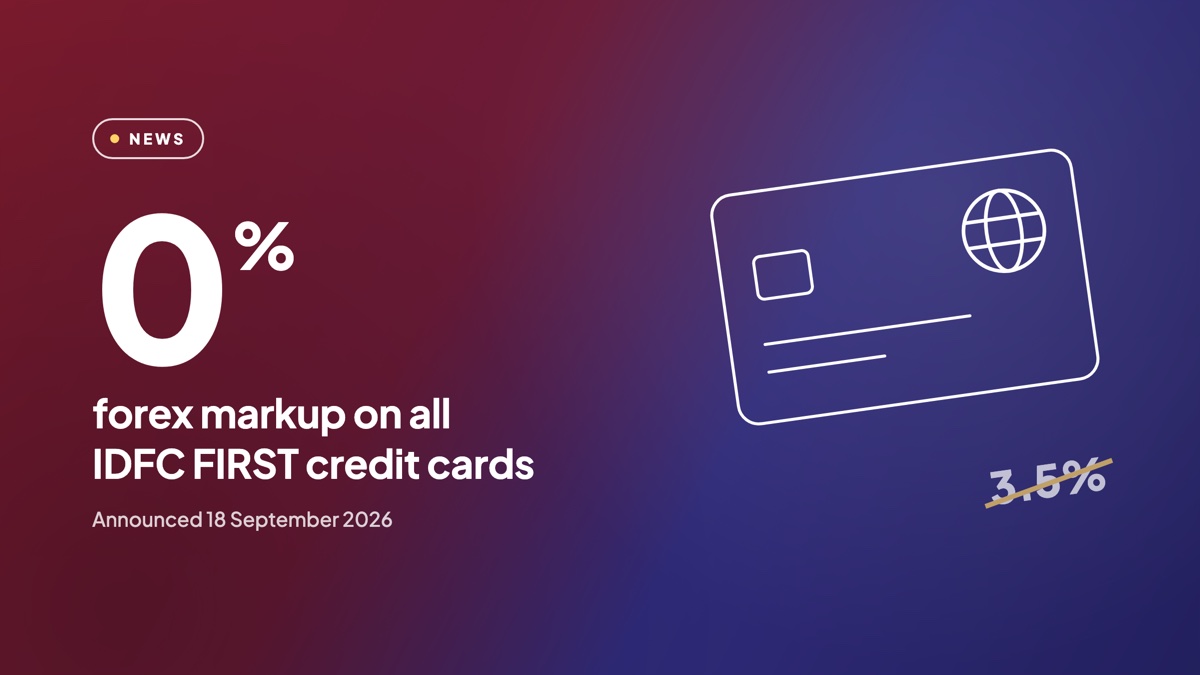
IDFC FIRST Bank has removed the forex markup fee on every one of its credit cards. The bank announced the change on Friday, 18 September 2026, and it applies to existing and new cardholders automatically. You do not need to apply for a new card, upgrade, or cross any spending threshold to get it.
That is unusual. Most Indian banks keep zero or low markup for a premium or travel card with a high annual fee. IDFC FIRST has applied it across its whole card range, including its lifetime free cards.
What changed
A forex markup is the fee a bank adds when you pay in a foreign currency. Until now, IDFC FIRST's published charges listed markups between 1% and 3.5% depending on the card, with 3.5% on several of them. GST at 18% was added on top of that fee.
From the announcement onwards, that markup is gone on all IDFC FIRST credit cards. According to the bank, this covers:
- Card payments made abroad, in shops, hotels and restaurants
- International online purchases billed in a foreign currency
- Subscriptions and software paid in dollars or other currencies
- Certain education and business expenses paid overseas
Reward points and cashback continue as per each card's existing terms. The bank has said zero markup is in addition to rewards, not a replacement for them.
How much you save
The bank's own example uses a card with a 3.5% markup. On ₹1 lakh of foreign currency spends, the markup would have been ₹3,500, plus ₹630 GST, so ₹4,130 in total. That charge is now zero.
Here is what the old markups would have cost you at different spend levels, including 18% GST:
- ₹25,000 spend: ₹1,033 at a 3.5% markup, ₹443 at 1.5%, ₹295 at 1%. Now ₹0.
- ₹1,00,000 spend: ₹4,130 at a 3.5% markup, ₹1,770 at 1.5%, ₹1,180 at 1%. Now ₹0.
- ₹3,00,000 spend: ₹12,390 at a 3.5% markup, ₹5,310 at 1.5%, ₹3,540 at 1%. Now ₹0.
The biggest gain goes to holders of entry-level IDFC FIRST cards, which carried the highest markups. A few cards, such as WOW! and Mayura, already had zero markup, so nothing changes for them.
What still costs money abroad
Zero markup does not make every international transaction free. A few things are outside this change:
- Dynamic currency conversion (DCC). If a shop, hotel or ATM abroad offers to charge you in rupees, say no and pay in the local currency. With DCC, the merchant picks the exchange rate, and it is usually worse than your card network's rate.
- Cash withdrawals. Taking cash from an ATM on a credit card still attracts a cash advance fee, and interest usually starts from the day you withdraw. The ATM owner may add its own fee too.
- The exchange rate itself. Your transaction is converted at the Visa, Mastercard or RuPay rate on the day it settles. Zero markup means the bank adds nothing on top, not that the rate is fixed.
- Rupee payments to overseas merchants. Some banks charge a separate cross-border fee when a foreign merchant bills you in rupees. The announcement covers foreign currency markup, so check IDFC FIRST's latest schedule of charges if you often shop on foreign sites that price in INR.
What about rewards on international spends?
Rewards follow each card's own terms, and some of those terms changed earlier this year. For example, the Ashva and Mayura cards cut the reward rate on international spends from 10X to 5X from 18 January 2026. So on those cards, you now pay no markup but earn fewer points abroad than you did a year ago. Check your card's reward terms before assuming the full rate applies overseas.
Do you still need a forex card?
For most people who use a forex card only to avoid credit card markups, an IDFC FIRST credit card now does the same job with less effort. There is nothing to load, no unused balance to convert back, and you keep your credit card's interest-free period and rewards.
A forex card can still make sense if you want to lock in an exchange rate before a trip, need to withdraw cash often, or are sending a student abroad with a fixed budget. Compare the exchange rate, ATM charges and reload fees on both before you decide.
Who benefits most
- Frequent travellers who were carrying a second card only for its lower markup
- Students and parents paying fees or living costs abroad on a card
- Freelancers and small businesses paying for software, hosting and ad tools billed in dollars
- Online shoppers who buy from international stores
If you do not hold an IDFC FIRST card yet, this changes the comparison. Zero markup used to be limited to premium cards with high fees or a few fintech co-branded cards. Now it is available on lifetime free IDFC FIRST cards too. You can see every IDFC FIRST card we track on our IDFC FIRST Bank cards page, and all low-markup options in our forex credit cards list.
What you should do
- If you already have an IDFC FIRST credit card, you do not need to do anything. The change applies automatically.
- Make sure international transactions are enabled on your card, in the IDFC FIRST app, before you travel or shop abroad.
- Always choose to pay in the local currency when a terminal or website asks.
- Avoid cash withdrawals on the credit card.
- Check your first international statement to confirm no markup was charged. If it was, raise it with the bank.
For background on how markup is calculated, read What Is Forex Markup on a Credit Card? and Zero Forex Markup Credit Cards Explained.
Frequently asked questions
Which IDFC FIRST credit cards have zero forex markup?
All of them. The bank says the change covers its entire credit card range, for existing and new customers.
Do I need to apply or upgrade to get zero forex markup?
No. It applies automatically, with no application, upgrade or minimum spend.
When did the change take effect?
The bank announced it on 18 September 2026 and said it is available to all cardholders from then on.
Will I still earn reward points on international spends?
Yes, as per your card's reward terms. Some cards earn a different rate on international spends, so check your card's terms.
Is withdrawing cash abroad free now?
No. Cash withdrawals still attract cash advance fees and interest, and the ATM may charge its own fee.