What Is Forex Markup, and How Much Does It Really Cost You?

It's a fee added on top of the actual exchange rate
When you swipe a card abroad or pay in a foreign currency online, your bank converts that amount to rupees using the Visa or Mastercard exchange rate for that day, then adds its own markup on top before billing you. This markup is the bank's fee for handling the currency conversion, it isn't part of the "real" exchange rate, and it's separate from any GST charged on top.
How much it actually is
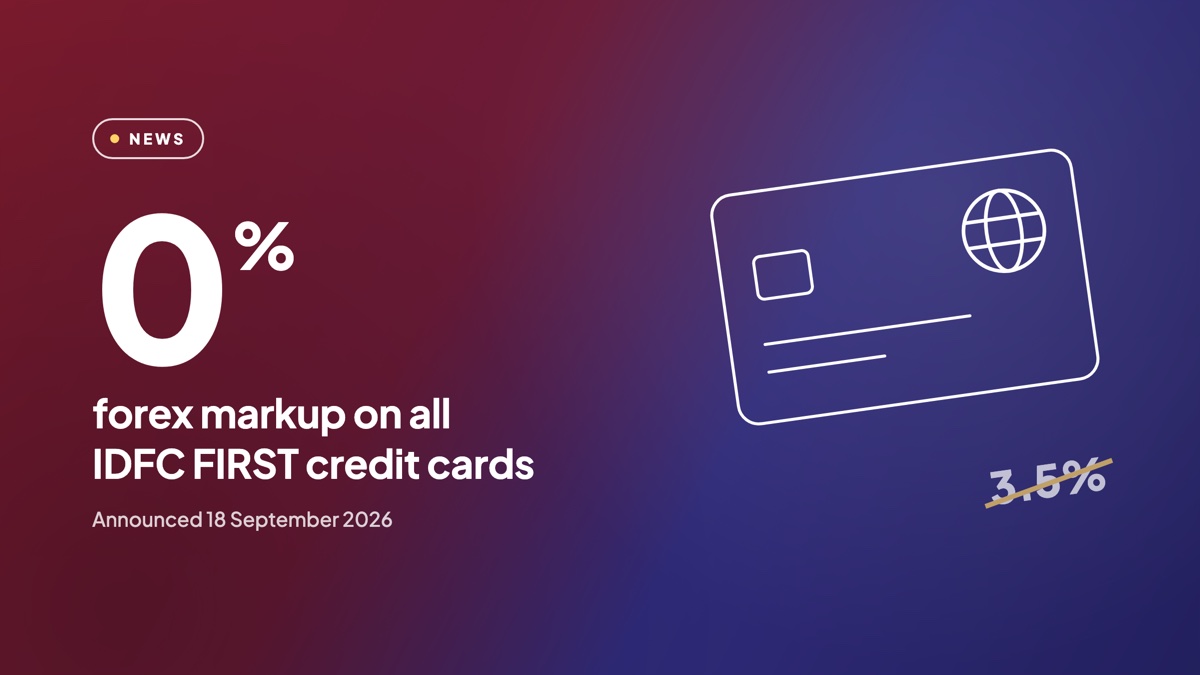
Most standard credit cards charge a forex markup of 1.5% to 3.5%, plus 18% GST on the markup itself. On a ₹1,00,000 international purchase at a 3.5% markup, that's ₹3,500 in markup fees alone, before GST, money that never shows up as a separate line item on your statement the way a late fee would, it's just baked into the converted rupee amount you're billed.
What this looks like on an actual trip
Say you're on a two-week Southeast Asia trip and put ₹1,80,000 of hotels, food, and shopping on a standard card with a 3% markup. That's ₹5,400 in markup alone, and the 18% GST on that fee adds another ₹972, so roughly ₹6,370 disappears into markup on a trip where you never see a single line item called "markup," it's just quietly folded into every converted rupee amount on your statement. The same spending on a zero-markup card costs nothing extra on the conversion, which is exactly the kind of gap that only becomes visible once you actually add it up across a full trip rather than one purchase.
Why it's easy to miss
Your statement typically shows the final rupee amount you were charged, not a breakdown of the base exchange rate versus the markup added on top. Two cards charging different markups on the identical purchase, at the identical moment, will show two different rupee amounts, and nothing on either statement explicitly flags "this is the markup."
Every international transaction counts, not just travel
This applies to any transaction billed in a foreign currency, which includes plenty of things that don't feel like "foreign travel": subscriptions billed by an overseas company, an app store purchase priced in dollars, or shopping on a website that settles in a currency other than rupees. If you spend online in USD regularly, forex markup can add up even if you never leave India.
The way around it
A growing number of cards now offer zero or near-zero forex markup specifically for this reason. We've covered how zero forex markup cards actually work and who they make sense for.